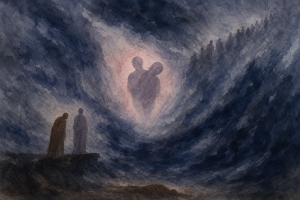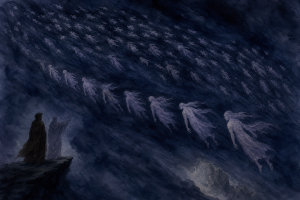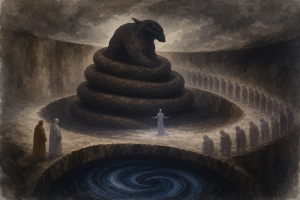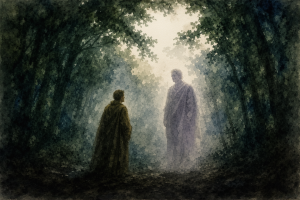
A clap of thunder wakes Dante on the far side of the Acheron — no boat, no crossing, no memory of how he got there — and the first thing he notices is that his guide has gone pale.
Inferno · Canto 4 · Lines 1–30 · Scene 10
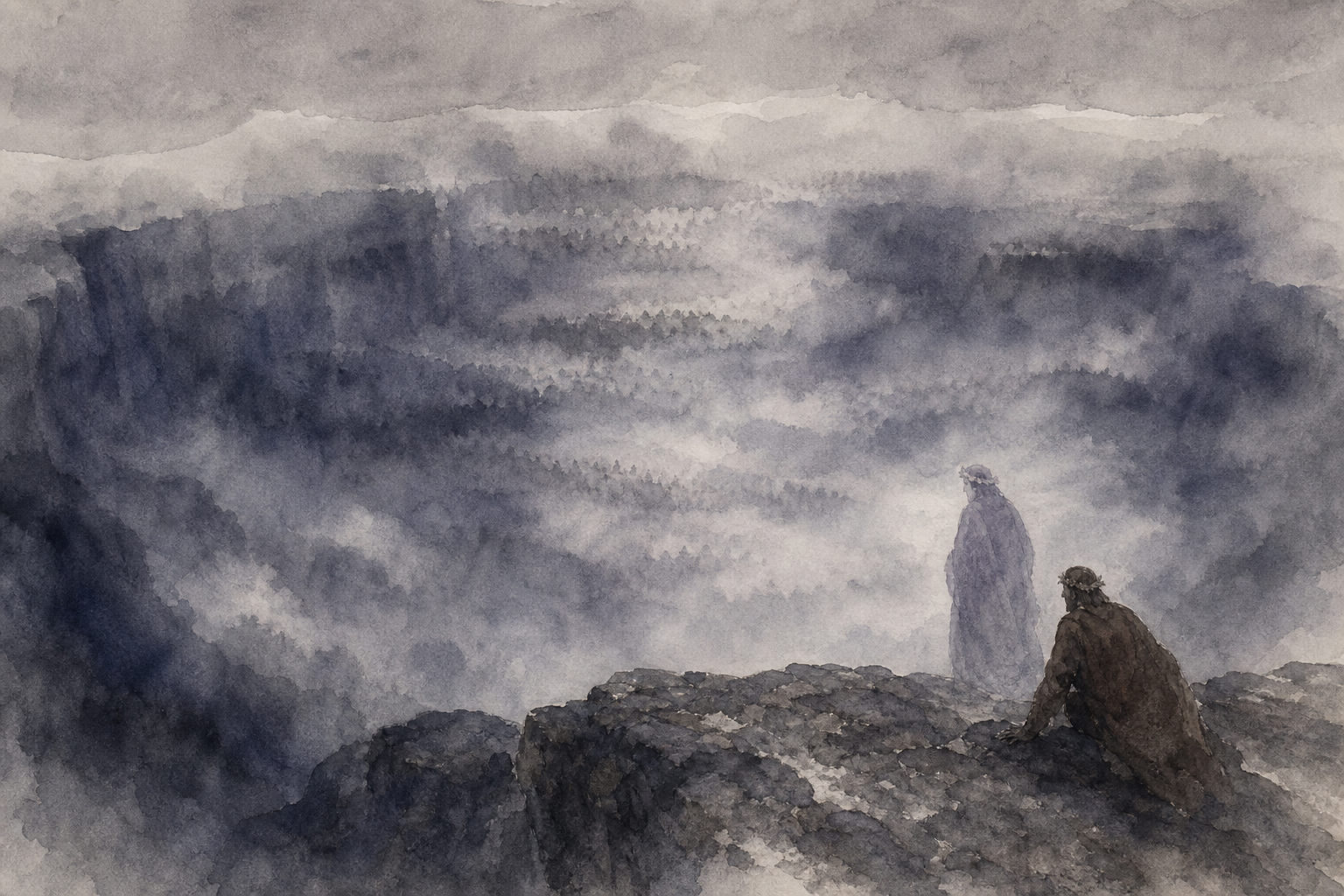
A heavy clap of thunder breaks the deep sleep that took Dante at the end of Canto 3, and he jolts upright like someone shaken awake by force. He looks around, rested and alert — and finds himself somewhere impossible. He is standing on the brink of the valley of the abyss, on the far side of the river Charon refused to carry him across. There was no boat, no crossing, no journey: the poem simply skipped it, and Dante has no more idea how he got there than the reader does. He stares down into the valley to get his bearings and sees nothing at all — it is too dark, too deep, too full of fog — but he can hear it: the whole abyss gathers into a thunder of endless wailing that rises out of the blackness. Then Virgil says it is time: down we go now, into the blind world, I will go first and you second. And Dante notices something that stops him cold — his guide has gone completely pale. How am I supposed to go, he asks, when you are afraid, you who have been the answer to every fear I have had so far? Virgil corrects him. It is not fear. The anguish of the people down there paints on my face a pity you are mistaking for dread. Then he cuts the conversation off: let’s go, the long road is pushing us. He steps down, and brings Dante into the first circle that rings the abyss. And here comes the strangest thing in the scene: it is quiet. After the shrieks and cursing and the din of Canto 3, this circle holds no crying at all — only sighs, enough of them to make the eternal air tremble. It is sorrow without torments, Dante says, and it belongs to enormous crowds: infants, and women, and men. The scene ends there, with the question hanging — who are these people, and what did infants ever do to end up in Hell? Virgil’s answer belongs to the next scene.
The Italian — Into the Blind World
Source: Wikisource (public domain, pre-1929 text)
Lines 1–3
1. Ruppemi l’alto sonno ne la testa2. un greve truono, sì ch’io mi riscossi3. come persona ch’è per forza desta;
literary key: Line 1 — ‘Ruppemi l’alto sonno’ — the deep sleep broke in my head. The canto opens inside the unconsciousness that ended Canto 3, and the syntax leads with the breaking: the crossing of the Acheron has already happened, unnarrated, somewhere inside that sleep. [Model knowledge · high]
translation note: Line 2 — ‘un greve truono’ — a heavy thunderclap, though commentators have long noted the word could also name the massed roar of the abyss that line 9 describes gathering ‘infiniti guai.’ Whether Dante is woken by weather or by the sound of Hell itself is left open by the word. [Model knowledge · medium]
Lines 4–6
4. e l’occhio riposato intorno mossi,5. dritto levato, e fiso riguardai6. per conoscer lo loco dov’io fossi.
literary key: Line 6 — ‘per conoscer lo loco dov’io fossi’ — to know the place where I was. The pilgrim’s first act on the far shore is orientation: standing upright, gazing fixedly, trying to work out his own location — a small, methodical gesture of self-possession immediately before the poem shows him a place that defeats sight altogether. [Model knowledge · medium]
vocabulary: Line 4 — ‘l’occhio riposato’ — the rested eye. The sleep was restorative, not merely a blackout; Dante wakes alert. The detail quietly distinguishes this collapse from ordinary fainting and gives the missing crossing the character of something done to him rather than suffered by him. [Model knowledge · medium]
Lines 7–9
7. Vero è che ‘n su la proda mi trovai8. de la valle d’abisso dolorosa9. che ‘ntrono accoglie d’infiniti guai.
literary key: Line 7 — ‘mi trovai’ — I found myself. The same verb of unexplained arrival that opens the poem (‘mi ritrovai per una selva oscura,’ Inf. I.2): both of the journey’s first decisive locations — the dark wood and the rim of Hell — are reached with the travel itself missing from the text. [Model knowledge · high]
translation note: Line 9 — ‘che ‘ntrono accoglie d’infiniti guai’ — which gathers the thunder of infinite wailings. The abyss is introduced as a funnel of sound before it is anything visible; ‘accoglie’ (gathers, receives) makes the valley itself the collector of its own grief. [Model knowledge · medium]
Lines 10–12
10. Oscura e profonda era e nebulosa11. tanto che, per ficcar lo viso a fondo,12. io non vi discernea alcuna cosa.
literary key: Line 12 — ‘io non vi discernea alcuna cosa’ — I could make out nothing there. The pilgrim’s first full look into Hell is a failure of sight: the abyss has already reached him through sound (line 9), but the eye, however fixedly he drives it downward (‘ficcar lo viso a fondo’), returns nothing. Hearing outruns vision at the threshold. [Model knowledge · high]
Lines 13–15
13. «Or discendiam qua giù nel cieco mondo»,14. cominciò il poeta tutto smorto.15. «Io sarò primo, e tu sarai secondo».
vocabulary: Line 13 — ‘cieco mondo’ — the blind world. The adjective cuts both ways: a world without light, and a world of the sightless dead. Dante has just demonstrated the first sense from the rim — he could see nothing — and the poem will spend the canto exploring the second. [Model knowledge · medium]
literary key: Line 14 — ‘tutto smorto’ — utterly pale, drained of color. The detail that drives the next two tercets: the poet-guide who has met the beasts, the vestibule, and Charon without flinching goes pale at this particular threshold — the rim of the circle that, though Dante does not yet know it, is Virgil’s own. [Model knowledge · high]
Lines 16–18
16. E io, che del color mi fui accorto,17. dissi: «Come verrò, se tu paventi18. che suoli al mio dubbiare esser conforto?».
literary key: Line 17 — ‘Come verrò, se tu paventi’ — how shall I come, if you are afraid? Dante reads his guide’s face the way he reads everything in this poem — closely — and misreads it. The pupil’s whole courage has rested on the guide’s composure, and the question exposes how conditional that courage is. [Model knowledge · high]
vocabulary: Line 18 — ‘che suoli al mio dubbiare esser conforto’ — you who are accustomed to be comfort to my doubting. ‘Suoli’ (are used to, habitually are) quietly summarizes the relationship the first three cantos have built: Virgil as the standing remedy for Dante’s recurring hesitation. [Model knowledge · medium]
Lines 19–21
19. Ed elli a me: «L’angoscia de le genti20. che son qua giù, nel viso mi dipigne21. quella pietà che tu per tema senti.
theology: Line 21 — ‘quella pietà che tu per tema senti’ — that pietà which you perceive as fear. The interpretive center of the scene: pietà in Dante’s Italian spans pity, grief, and piety, and whether Virgil’s pallor holds compassion for others or grief at returning to his own circle is the question the two-camp debate below takes up. [Model knowledge · high]
literary key: Line 20 — ‘nel viso mi dipigne’ — paints on my face. The anguish of others is rendered as a painter working on Virgil’s features from without: emotion arrives on the face as an image made by someone else’s suffering, which is precisely what allows Dante to misread it. [Model knowledge · medium]
Lines 22–24
22. Andiam, ché la via lunga ne sospigne».23. Così si mise e così mi fé intrare24. nel primo cerchio che l’abisso cigne.
literary key: Line 24 — ‘nel primo cerchio che l’abisso cigne’ — into the first circle that girds the abyss. The quietest threshold crossing in the poem so far: after an inscribed gate and a ferryman who had to be silenced by formula, entry into Hell’s first circle takes half a line — no gate, no guardian, no challenge. [Model knowledge · high]
vocabulary: Line 22 — ‘la via lunga ne sospigne’ — the long way pushes us on. Virgil ends the exchange about his pallor by invoking the road itself as the agent of urgency — the journey, not the guide, is made to do the insisting, and the subject of his face is closed without being resolved. [Model knowledge · medium]
Lines 25–27
25. Quivi, secondo che per ascoltare,26. non avea pianto mai che di sospiri27. che l’aura etterna facevan tremare;
literary key: Line 26 — ‘non avea pianto mai che di sospiri’ — no weeping, only sighs. The first circle is defined by acoustic subtraction: after the shrieks, cursing, and din of Canto 3, Limbo announces itself as the absence of all that. The poem again characterizes a region by sound before sight — ‘secondo che per ascoltare,’ according to what listening could tell. [Model knowledge · high]
translation note: Line 27 — ‘l’aura etterna facevan tremare’ — they made the eternal air tremble. The sighs are individually quiet but collectively physical, enough to shiver the air of the place forever; grief at scale becomes climate. [Model knowledge · medium]
Lines 28–30
28. ciò avvenia di duol sanza martìri,29. ch’avean le turbe, ch’eran molte e grandi,30. d’infanti e di femmine e di viri.
theology: Line 28 — ‘duol sanza martìri’ — sorrow without torments. Limbo’s punishment is a state, not an infliction: nothing is done to these souls, and that privative condition — loss without pain — is the theological signature of the circle, elaborated when Virgil explains at IV.42 that its residents live in longing without hope. [Source: Singleton, Inferno: Commentary (1970)]
theology: Line 30 — ‘d’infanti e di femmine e di viri’ — of infants, and of women, and of men. Infants come first in the catalogue: the unbaptized children of the medieval limbus puerorum, placed inside Hell’s geography. The word is allowed to land without comment here; the doctrinal weight it carries is taken up in the canto’s next movement. [Model knowledge · high]
Seven Centuries of Reading Into the Blind World
The Medieval Commentators: Allegory and Moral Order
The earliest readers treated the poet ‘tutto smorto’ (14) — gone completely pale — as a problem of allegory, not psychology. Pietro Alighieri, writing in the mid-fourteenth century, read Virgil as Reason personified: reason naturally recoils before the spectacle of sin and suffering, and the pallor is philosophy’s proper response to the abyss, not a personal emotion. Boccaccio’s Esposizioni — the public lectures that break off partway through Canto 17 — does reach this canto; his method, a literal exposition of each canto followed by an allegorical one, kept Virgil legible on both levels at once: the historical Roman poet, and the figure of natural wisdom guiding fallen humanity.
The Ottimo Commento and Benvenuto da Imola pressed further into literal detail. Benvenuto, writing in the 1370s and 1380s, read ‘quella pietà che tu per tema senti’ (21) — that pity you feel as fear — with something close to biographical sympathy: Virgil suffers, Benvenuto observed, what any noble pagan must suffer, through no moral fault of his own. That sympathy, however, stopped short of the modern question: Benvenuto did not ask whether Virgil’s stated explanation for his pallor might be incomplete. For medieval commentators generally, the poem’s moral architecture was its stable truth, and moments of ambiguity were resolved by mapping them onto that architecture.
Renaissance and Early Modern Readers: The Poet Over the Theologian
Humanist readers of the fifteenth and sixteenth centuries shifted their attention from allegory toward language and literary form. They were less interested in what Virgil’s pallor meant theologically than in how Dante handled the encounter as a poet. Cristoforo Landino‘s 1481 commentary read the opening of Limbo as a showcase of Dante’s debt to the classical tradition — the sighs that make the eternal air tremble (‘sospiri / che l’aura etterna facevan tremare,’ 26–27), the absence of torment, the distinguished spirits of Canto 4 — all became evidence of Dante’s deliberate imitation and transformation of Virgil’s own underworld in the Aeneid.
That comparative approach dominated early modern reading. Dante’s scene was measured against its Latin sources, and the pathos of the exchange between the two poets was appreciated as literary craft. The theological problem — an unbaptised soul guiding a Christian pilgrim, ‘tutto smorto’ at the rim of his own eternal home — interested humanists less than the technical achievement. The strangeness of Virgil returning to his own Limbo was acknowledged. Few pursued it.
The Nineteenth Century: Emotion as Evidence
Francesco De Sanctis changed the terms of reading entirely. In his influential History of Italian Literature (1870–71), De Sanctis argued that Dante’s greatness lay in his creation of living characters — figures whose emotional reality exceeds their allegorical function. Virgil here is not a personification of Reason but a person. His pallor is the pallor of a soul who feels. De Sanctis recovered the humanity of the scene at the cost of some of its doctrinal structure, and Romantic readers across Europe followed his emphasis on interiority and feeling.
That recovery was also, in part, an invention. De Sanctis’s Dante was reshaped to fit a Romantic model of the suffering artist. The theological precision of the original — the exact weight of pietà, the grammar of grieving for others while being one of them — received less attention than the emotional texture. Nineteenth-century readers gave future scholars a Virgil easy to love, and a set of questions they would spend the next century complicating.
Twentieth-Century Criticism: Three Major Lines
Charles Singleton‘s theological reading, developed across his major studies and commentary, treated Dante’s poem as a structured imitation of sacred scripture. Every element of the poem — including Virgil’s emotional display — participates in a coherent theological design. Virgil’s limitation is the limitation of unaided reason: real but bounded, capable of feeling ‘l’angoscia de le genti’ (19) but not of transcending its own condition. The pallor is genuine; its meaning is contained within a system Dante controls.
Erich Auerbach offered a different frame. His concept of figural realism held that Dante’s characters are simultaneously historical persons and signs of something beyond themselves, without either function cancelling the other. Virgil’s emotion is real because the historical Virgil is real — and it points beyond itself precisely because that reality is taken seriously. Teodolinda Barolini pushed back against both. Approaches that treat Dante as a controlled theological system, she argued, tend to naturalise the poem’s claims about itself. Her secular-poet argument urged readers to treat Dante as a maker of textual effects, not a transparent guide to doctrinal truth — which means taking Virgil’s double position, as explainer and as subject, as a deliberately constructed instability rather than a problem to be resolved.
The Scene Today: Open Questions in Digital and Current Scholarship
The pallor of line 14 now carries seven centuries of stacked glosses, and projects like Columbia’s Digital Dante have made that whole record — Pietro Alighieri to the present — searchable side by side. The accessibility has sharpened the live questions, not settled them. Readers can now trace, across seven centuries, every time a commentator chose to read Virgil’s pallor as compassion and every time one edged toward self-recognition — and the split does not resolve along chronological lines.
Current scholarship remains divided on two problems this passage leaves open. One is textual: Dante places the crossing of Acheron entirely outside the narrative — the pilgrim sleeps through it, and no account is given. Commentators from Benvenuto onward have proposed explanations. None has stuck. The other is interpretive: the word pietà, joining Virgil’s explanation to his later admission, carries pity, grief, and piety at once. Scholars who favor the Compassionate Guide reading and scholars who favor the Self-Recognition reading are, as both camps acknowledge, quoting the same word. That Dante left it that way — with one word doing the work of two readings simultaneously — is itself a position that current criticism is still in the process of arguing through.
The Two Main Positions on Into the Blind World
The Compassionate Guide Reading
Virgil’s pallor means what Virgil says it means: the anguish of the souls below, painted on the face of a guide humane enough to feel it. On this reading the exchange is a lesson in reading correctly — Dante mistakes pity for fear, and is corrected — and its function is to establish Virgil, at the threshold of Hell proper, as a figure of feeling reason: the guide suffers on behalf of others what the journey will require his pupil to witness. His later admission of residence in Limbo does not retroactively convert the pity into self-pity; it deepens its authority, since he grieves for a condition he knows from inside.
Key passage: Inf. IV.19–21 — Virgil’s own words assign the pallor an explicit external object: ‘L’angoscia de le genti / che son qua giù, nel viso mi dipigne / quella pietà che tu per tema senti’ — the anguish of the people down there paints on my face that pity you feel as fear.
The Self-Recognition Reading
The circle Virgil is about to enter is his own eternal dwelling, and the pallor is the face of a soul returning home to a hopeless place. On this reading his explanation is not false but displaced: he names the anguish of ‘the people down there’ because the truth — that he is one of them — is nine lines away and almost unbearable to say while standing at the rim. The canto then supplies the correction itself: ‘di questi cotai son io medesmo,’ and a condition described in the first person plural, without hope, living in longing. The word pietà, on this account, lets Virgil grieve for himself under the grammar of grieving for others.
Key passage: Inf. IV.39 and IV.42 — ‘e di questi cotai son io medesmo’ (and of just such as these am I myself) and ‘sanza speme vivemo in disio’ (without hope we live in longing): the guide’s own membership in the circle, stated in his own voice, in the first person plural.
What the Text Does — and What That Means (Contested)
On the page: The text supplies, in sequence: the pallor (IV.14), Dante’s misreading of it as fear (IV.16–18), Virgil’s own explanation naming the anguish of others as its cause (IV.19–21), and, shortly after, Virgil’s statement that he is himself one of Limbo’s residents, delivered in the first person plural (IV.39, 42). The poem never states what proportion of the pallor belongs to compassion and what to self-recognition.
What scholars dispute: Whether Virgil’s explanation at lines 19–21 is complete and honest (the pallor is what he says it is), incomplete in a way the canto quietly exposes nine lines later (the grief is also, or mostly, his own), or deliberately voiced through a word — pietà — whose range Dante exploits precisely because it will not resolve, is not settled by the text; the three readings assign very different weights to Virgil’s reliability about his own inner state.
What Dante Leaves Unresolved
Two silences frame the scene, and the text closes neither. The poem never narrates how a living man crossed the Acheron — Dante sleeps through his own crossing, and whatever carried him over is left permanently outside the text. And the poem never apportions Virgil’s pallor: his explanation names the anguish of others, his admission nine lines later places him among them, and the word joining the two, pietà, carries pity, grief, and piety at once. Readers who want the pallor to be compassion, and readers who want it to be self-recognition, are both quoting Virgil accurately — which may be the most carefully engineered feature of the scene.
The Open Question
When Virgil goes pale at the rim of the abyss and explains that the anguish of those below paints pity — pietà — on his face, while the circle he is describing is the one he himself inhabits forever, is Dante showing us a guide who grieves for others, a damned soul returning to his own eternity, or a poet choosing the one word that refuses to decide between them?
Explore More
About This Article

Written by Lucy Bamboo. Lucy Bamboo has been reading the Divine Comedy for fifteen years — first in translation, then stubbornly in Medieval Tuscan with a dictionary and far too many footnotes. Reading Dante is her scene-by-scene walk through the poem: the original Italian, seven centuries of scholarly argument presented as argument rather than answer, and the human questions sitting underneath the theology. More about this site.
Verify this against a primary source
Specifics change, and your situation may differ from the one described here. These are the authorities worth checking directly:
- Digital Dante, Columbia University — text, commentary and translation apparatus
- Princeton Dante Project — the Commedia with historical commentary
- Dartmouth Dante Project — searchable commentary from 1322 onward