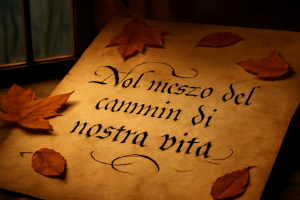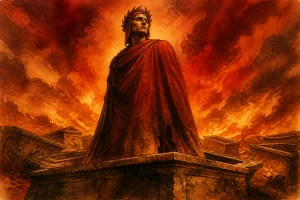
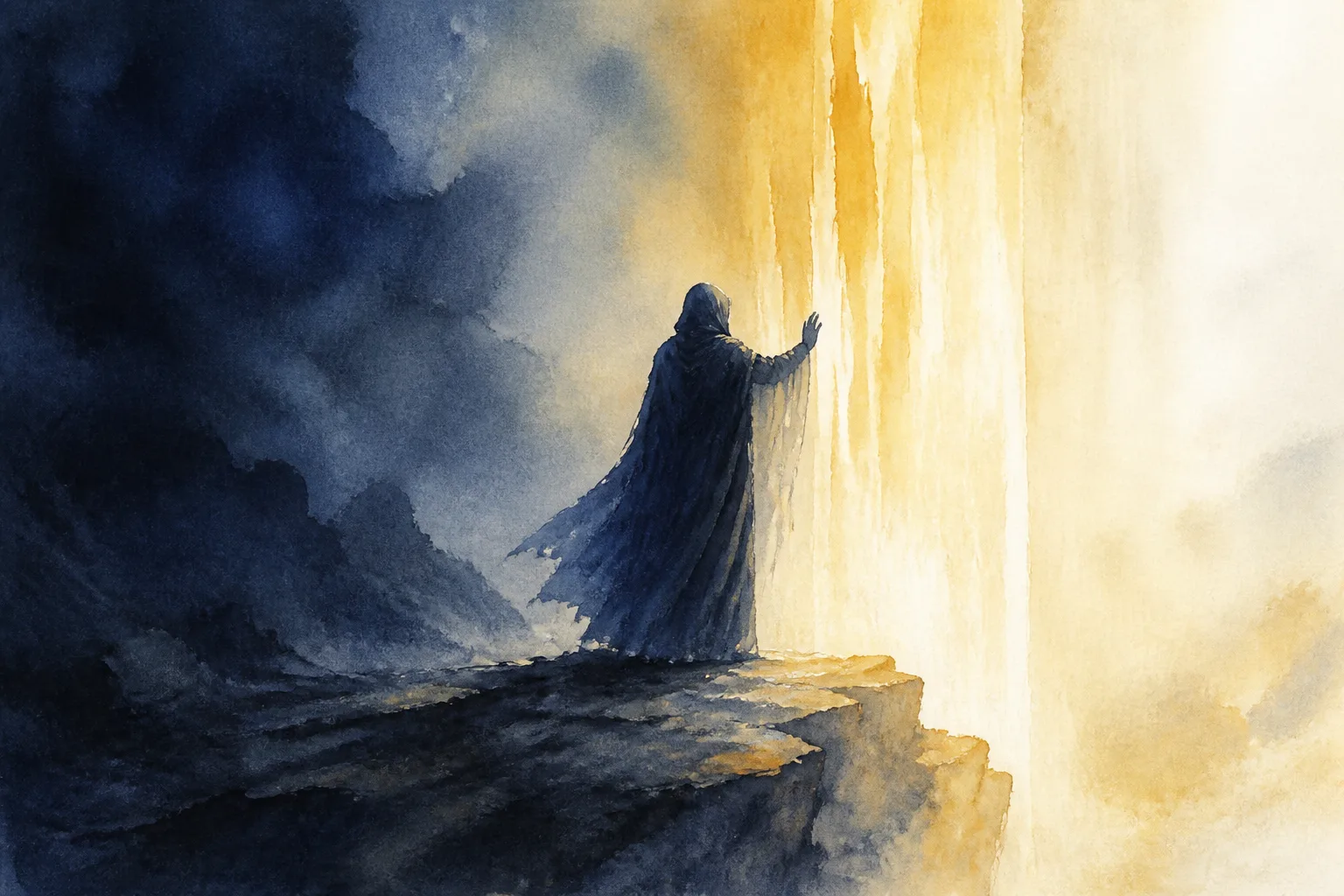
Faith, in the version most people inherit, is the assumption you start from — the floor you stand on before any of the hard questions begin. Dante’s poem says something harder: faith is what’s left over after thinking has gone as far as it can and discovers it isn’t far enough. That’s not comfort. That’s a cliff. What the Comedy actually stages isn’t what you should believe, but what you do at the exact edge of what you can know — when the map runs out and you still have to take the next step.
The real question the poem puts to you isn’t theological. It’s existential. And it starts with a detail that most introductions to Dante get exactly backwards.
The Least Likely Poet of Faith
Dante Alighieri was, by any measure, a reason person. This is the man who wrote the Convivio, the unfinished philosophical encyclopedia in which he attempted to systemize all human knowledge and called Aristotle “the master of those who know.” He sorted his sinners by the ethics of the Nicomachean Ethics, mapped moral failure with the precision of a scholastic argument, and thought through Hell the way a philosopher thinks through a proof: methodically, category by category, with everything in its correct place. He loved reason. He trusted it the way you trust a well-made instrument.
Which makes him, on paper, the worst possible candidate to write the great poem of Christian faith.
The Comedy didn’t come from someone for whom belief arrived naturally or easily. Someone wrote it who had to be walked toward the thing his intellect couldn’t deliver — argued with, coaxed, frightened, and dragged. Dante-the-pilgrim doesn’t arrive at faith because it was always obvious. He arrives because every other option runs out. Faith, in this poem, isn’t the starting assumption. It’s the last conclusion. Hard-won, not native.
That inversion matters. It means the poem isn’t for the credulous. It’s for everyone who tried reason first and found where reason stops.
The Guide Who Cannot Follow You Home
Here is the cruelest structural fact in the Comedy, and the one that most changes what the poem means: Virgil is damned.
Not damned for anything he did. Virgil — the Roman poet who guided Dante through all of Hell, who answered every question, steadied every panic, corrected every misplaced pity, and explained the logic of punishment across thirty-four cantos of the Inferno — lives in Limbo forever, separated from God not by any moral failure but simply by when he was born. He came before the faith that would have saved him. He represents, in the poem’s economy, human reason at its absolute peak: what the unaided intellect achieves when it reaches highest. And the poem’s answer to that peak achievement is: not enough. Not by itself. Not all the way.
Virgil guides Dante through Hell and up nearly all of Purgatory. He can get you almost all the way. Through every horror, past every danger, up the entire mountain — and then he stops at the threshold of the thing that matters most and cannot go further. In Purgatorio Canto XXX, Beatrice appears at the summit, and Virgil is simply gone. Dante turns to tell Virgil what he’s feeling, the way you turn to tell someone news, and Virgil isn’t there. The guide who never left his side has vanished, wordlessly, because he cannot go where Dante is going. “Virgil, Virgil, Virgil” — Dante calls his name three times, like someone calling into an empty house.
Where Reason Hits Its Ceiling
The being who taught Dante to think — his intellectual father throughout the journey — cannot enter the destination. The poem makes this claim through architecture rather than argument: the faculty you most trust has a ceiling. Reason is your guide, your companion, your protector. It cannot follow you home.
That ceiling is exactly where faith begins. Dante makes you feel the loss of Virgil — genuinely feel it, not just register it as a theological datum — so you understand what faith replaces and how much that replacement costs. The cost of human reason’s limits is always paid in someone you love. That’s not incidental to the poem’s structure — it is the poem’s argument.
When Heaven Asks: What Is Faith?
Most readers who know this poem know the descent. Fewer know what happens near the top.
In Paradiso Canto XXIV, Saint Peter appears — not to welcome Dante, not to confirm his arrival. To examine him. Before Dante can ascend further into the celestial spheres, Peter puts him through a formal interrogation on the nature of faith. The scene has no warmth in it. It’s structured as a medieval university disputation: define the term, justify the definition, account for the evidence, withstand follow-up. Heaven’s gatekeeping is forensic. The question is: what is faith? The examination runs over a hundred lines.
Dante answers with scripture: faith is “the substance of things hoped for, the evidence of things not seen.” Peter accepts the definition and immediately pushes deeper. Where does your evidence come from? Scripture, Dante says. And what establishes Scripture’s authority? The miracles that attest to it. And where are those miracles recorded? In the Scripture whose authority they’re supposed to establish. The argument is circular — Dante knows it, Peter knows Dante knows it — and what’s actually being tested isn’t the answer. It’s whether Dante has thought hard enough about faith to have felt its difficulty, rather than merely inherited its vocabulary.
Peter approves the answer. And then, in Canto XXV, James appears to examine Dante on Hope. In Canto XXVI, John examines him on Love. The summit of the poem is a series of oral defenses. Faith isn’t a warmth you arrive into — it’s a gauntlet you run. What does it mean that the most spiritual territory in the poem is structured like a final exam? That faith, even in Heaven, has to be earned by articulation rather than received by grace? Dante passes every time. The examiners remain.
The Case for the Cliff
Before this tips into the conclusion that faith is merely unjustified belief in better clothing, stop. There’s a stronger argument — and it’s not a religious one. It’s a human one.
We act past our knowledge constantly. You love a person without proof they won’t leave. You commit to a city, a career, a version of yourself, before the evidence arrives. You trust the bridge not because you’ve stress-tested every bolt but because you walk across and find out. Every significant choice comes before the information that would, in principle, justify it — because that information only exists on the other side of the choice. A marriage cannot be proved right before you’re in it. A vocation cannot sustain you before you’ve spent years at it.
Faith, on this reading, isn’t believing things without evidence as a failure of reason. It’s the universal human act of committing before the evidence is complete — because waiting for completeness means never moving at all. Reason excels at analyzing what’s already there. It cannot authorize the step into what isn’t yet. Dante’s pilgrim stepping into Paradise does the same thing anyone does stepping into a future they can’t see. This is where the poem’s deeper argument about free will lands: commitment without certainty isn’t irrationality. It’s what free action looks like from the inside.
Doubt Is the Medium, Not the Obstacle
Dante’s pilgrim is the proof of that principle — not the argument for it, but the living instance of it.
The popular framing — faith versus doubt, believers versus skeptics — doesn’t survive contact with this poem.
Dante’s pilgrim carries doubt through the entire journey. Francesca’s story fells him — he faints in front of her. Confusion and terror trail him through circle after circle; he peppers Virgil with questions, often failing to understand the answers. At the start of the Inferno, he almost refuses the journey because he cannot see his own fitness for it — he is not Aeneas, not Paul, and the gap feels like an argument against going. Paradise itself disorients him, his ordinary sight failing, his senses overwhelmed. If faith were the absence of doubt, this would be the least faithful poem ever written.
But notice what the doubt never does: it never stops the pilgrim from taking the next step. He faints, then gets up. He questions, then follows. He is overwhelmed, then continues. The doubt is constant; the direction doesn’t change. Which means the question “what is faith” might be a category error if we’re looking for a state — some condition of settled certainty that replaces the uncertainty. What the poem shows instead is that doubt and faith aren’t opposites. Doubt is the medium faith moves through. The pilgrim doesn’t believe in spite of not knowing. He moves in the direction of what he can’t yet see, while the not-knowing stays fully present.
“What is faith” might not be answerable as a noun at all — only as a verb. Only as a direction you keep choosing, one step at a time, with the doubt still in your body.
The Road That Runs Out
You came here wanting “what is faith” answered. Here is the honest version of what Dante offers instead.
He gives you a portrait of a deeply rational man — one who built his entire poem on borrowed philosophical architecture, who loved his guide more than almost anyone in the story, who followed reason all the way to the edge of what reason can reach — and then felt reason stop. Felt Virgil go quiet and disappear. Stood at the boundary between the mappable and the unmappable with nothing left but the direction he was pointed.
And stepped anyway.
The poem doesn’t tell you that step was obviously correct. No theodicy, no proof, no guarantee. A man who had thought harder about these questions than almost anyone else chose, at the exact moment when thinking stopped being sufficient, to keep going. From inside the poem, you can’t tell whether that step represents genuine vision or a very committed leap into darkness. Dante himself, back in the daylight, says he can barely remember what he saw — the light exceeded his capacity to hold it. The final cantos of the Comedy are famously the hardest to read, not because the theology is difficult but because the poem keeps describing something that description fails to reach.
Maybe faith isn’t something you have — only something visible in the instant you keep going after the road runs out.
Virgil stayed damned. The exam was real. The step was unguaranteed.
Dante stepped. He didn’t get certainty first.
The cliff is still there.
About This Article

Written by Lucy Bamboo. Lucy Bamboo has been reading the Divine Comedy for fifteen years — first in translation, then stubbornly in Medieval Tuscan with a dictionary and far too many footnotes. Reading Dante is her scene-by-scene walk through the poem: the original Italian, seven centuries of scholarly argument presented as argument rather than answer, and the human questions sitting underneath the theology. More about this site.
Verify this against a primary source
Specifics change, and your situation may differ from the one described here. These are the authorities worth checking directly:
- Digital Dante, Columbia University — text, commentary and translation apparatus
- Princeton Dante Project — the Commedia with historical commentary
- Dartmouth Dante Project — searchable commentary from 1322 onward