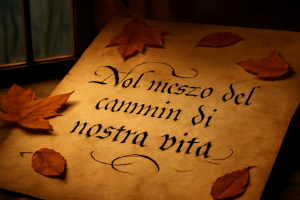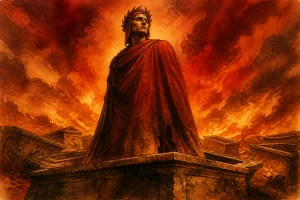
We’ve been taught to ask whether God is loving. The ruder question — the one Dante actually stages, in granular architectural detail, for every reader who has ever cracked open the Inferno — is whether a God who designed Hell could possibly be. Not Hell as vague backdrop to a morality tale, but Hell as Dante renders it: a structured, tiered, bureaucratically specific system of eternal suffering, complete with walls, moats, gates, and an inscription over the entrance that reads, in most translations, something like “Justice moved my maker on high. Divine Power made me, Wisdom Supreme, and Primal Love.” The gate to the eternal punishment complex was built by love. Dante planted that in Canto III, walked through it, and never quite explained himself.
Most discussions of God and justice want to resolve this fast. Either God is merciful and the harsh parts are metaphorical, or God is just and the harsh parts are deserved, and either way we can close the question and go home. What Dante refuses to let us do is go home. He keeps the question open across thirty-four cantos of descending circles, and he does it by sending a man who clearly believes in all of this — the justice, the order, the love behind the gate — to walk through it weeping.
The Exquisite Machine
What makes Dante’s Hell philosophically disturbing — as opposed to merely horrifying in the way any vision of suffering is horrifying — is its precision. This is not a dungeon where the wicked are thrown together and left to rot randomly. Each punishment mirrors its corresponding sin in a principle scholars call the contrapasso, or counter-suffering: the precise inverse of what was chosen in life, made permanent. The diviners who presumed to see the future have their heads twisted backward on their necks, forced to walk forward while seeing only where they have been (Canto XX). The flatterers who covered everything in honeyed words are submerged in excrement (Canto XVIII). The fraudulent advisers who used eloquence to deceive are sheathed in individual flames, speaking from inside their own burning tongues (Canto XXVI). Each punishment is a logical completion of its sin. The system is coherent. It almost hums.
And this elegance is the problem. Random cruelty is monstrous, but designed cruelty is worse. Random cruelty is the monstrousness of stupidity or rage — it implies an executioner who wasn’t thinking very hard. Designed cruelty, cruelty that has been thought about and arranged with care, carries an additional horror: someone matched these sufferings to these souls with the attention of an architect. The precision is exactly what unsettles. When you notice how well each punishment fits, you are noticing how much thought went into it. Does perfect justice, carried to its logical conclusion for all of eternity, start to look like perfect coldness? Dante doesn’t answer. He just keeps descending.
The Pilgrim Who Keeps Crying
Then the poem does something strange. The hero stops cooperating with the system he’s being shown.
In Canto V, Dante-the-pilgrim meets Francesca da Rimini, one of the lustful, swept eternally in a dark wind alongside her lover Paolo. She tells him their story — how they were reading of Lancelot, how the book itself became a catalyst for their desire, how they kissed and were discovered and killed. It is, as stories of human weakness go, unbearably human. And Dante — who knows perfectly well why they are here, who believes in the justice of the arrangement — listens to her, and faints. “And fell as a dead body falls.” He doesn’t deliver a verdict. He doesn’t nod gravely at the theological correctness of it. He collapses from pity.
This keeps happening. The pilgrim weeps. He is moved by the sufferings of the damned. He treats them not as cautionary illustrations of moral categories but as people. And in Canto XX, when he weeps over the diviners whose bodies have been twisted so that their faces look backward over their own shoulders, Virgil turns on him sharply. The line is famous: qui vive la pietà quand’è ben morta — “here pity lives when it is altogether dead.” Feeling compassion for the damned is, within the logic of the poem, a spiritual error. The God-sanctioned guide has to discipline the hero’s mercy to keep the tour on track.
This is the crack in the architecture. Virgil is the voice of right reason, commissioned by Heaven, endorsed by Beatrice herself. When he tells Dante that compassion is wrong here — that being moved by suffering is a fault, a failure of understanding — we are meant to take him seriously. But the poem also lets us notice what this requires. To suppress mercy is to deny the humanity of the damned. Either the pilgrim is wrong to feel what he feels, or there is something the system cannot afford to have him feel. Dante-the-poet offers both possibilities in the same canto and then moves on to the next circle without resolution.
Born Too Early
The hardest case in the poem, the one Dante seems unable to look at directly, is Limbo.
Canto IV. The first circle of Hell, reserved not for the wicked but for those who lived before Christ or died without baptism — condemned not for any moral failure, not for any choice they could have made differently, but for the timing of their birth. Virgil is there. Homer is there. Aristotle, Cicero, Ovid, Saladin, Averroes — the finest minds the pre-Christian world produced, gathered in a luminous castle in the dark, separated forever from the God who, by their own best lights, they would have recognized and honored had they been given the chance. The suffering is not physical; it is the permanent ache of longing for something just out of reach. “Sighing that keeps the air forever trembling.”
Dante fills Limbo with everyone he most admires. He loads it with the people he most wants to have been vindicated — the minds he thinks most clearly, the figures whose wisdom he most reveres — and then lets the injustice sit there without resolving it. There is no speech justifying the arrangement. There is no angel who descends to explain why this is fair. There is only the noble castle in the dark, and the faces of people who did everything right by every human measure, and the answer: wrong time, wrong place, no appeal.
This is where “is God judgmental” sharpens into something harder: is God fair? Dante, who built this place out of his own theological conviction, seems unable to stop staring at the gap between what these souls deserved by human accounting and what they received by divine decree. He can’t look away from his own architecture. After a while, neither can you.
The Price of Mattering
But I want to stop here and argue the other side seriously, because it deserves to be argued seriously. The defense of divine judgment is not “God is nice” or “everything happens for a reason.” The actual case is stranger and more demanding than either of those.
It is this: judgment is the price of mattering.
Consider what a universe without consequence actually looks like. Not a merciful universe — an indifferent one. If what you do with your life carries no ultimate weight, if the saint and the torturer arrive at the same nothing, then your choices don’t really mean anything beyond their immediate effects. You are not, in any deep sense, free. Freedom requires that choices be real, and choices are only real if they have genuine consequences that persist. A universe where everything is forgiven in the end is not a universe where anything is truly chosen. It is a universe where moral action is theater, performed for an audience that doesn’t care.
Dante’s God judges because Dante’s God takes the soul seriously. The contrapasso, read charitably, is not cruelty imposed from outside. It is the soul becoming the visible, permanent shape of what it loved and chose. The gluttons who made appetite the center of everything are submerged in filth in Canto VI, not because God is punishing them with something foreign to their nature, but because appetite without restraint was what they were — and now they inhabit that completely. The violent who gloried in domination are submerged in boiling blood in Canto XII, because domination and blood were the substance of their pleasure. The punishment is not a foreign imposition. It is revelation: the soul made legible, its choices rendered permanent and visible.
Aristotle — who is in Limbo, which lends the point an uncomfortable irony — argued that we become what we repeatedly do. Character is habit made permanent. Dante takes this seriously enough to render it architecturally, in graded circles where each level is a permanent portrait of a way of being human. On this reading, a judgmental universe is simply a universe in which what you love and choose actually constitutes you. If you want a world where your choices have weight, you want a world where they can have terrible weight. These are the same desire. The discomfort of Dante’s Hell is the discomfort of taking human freedom seriously all the way to its conclusion — and that case deserves to be held, not dismissed. A believer can stand in it. So, for a long time, can I.
Whose Judgment Is It, Anyway?
And yet. Here is the move in the poem I find most unsettling, the one I keep returning to.
Look at how the souls actually arrive in Hell. Charon, the ferryman of Canto III, tells Dante something strange about his passengers: they don’t need to be compelled. “Their fear is turned to longing.” They want to cross. Minos, the judge of Canto V, doesn’t pronounce elaborate sentences from a throne before dragging souls to their assigned circles. The souls confess to him, and his tail wraps around his body to indicate the number — but the confessing is the souls’ own act. The system is, to a significant degree, self-reporting. The damned arrive knowing, at some level, where they belong.
If this is true — if the damned are, in some deep sense, exactly where they insisted on being — then the question “is God judgmental” may be pointing at the wrong subject entirely. The horror might not be an external God handing down sentences. It might be the far more uncomfortable idea that we become, permanently, what we love — and that love, extended without correction, is its own verdict.
What if judgment isn’t something God does to us but something we do to ourselves, and what Dante calls Hell is simply the honest completion of that process? The word “judgmental” carries the image of an authority deciding from outside. But Dante keeps suggesting — between the fainting and the weeping and the careful symmetry of each punishment — that the damned are not being assigned their fates so much as finishing them. The soul becomes the permanent shape of its choices. “Judgmental” is perhaps the wrong word entirely. “Honest” might be closer. And an honest universe is far more frightening than a merely cruel one. A cruel God you can argue with. An honest universe just shows you what you were.
What the Poem Won’t Decide
None of that resolves it. I want to be clear about that.
The reader who comes to Dante expecting either acquittal or conviction is going to leave unsatisfied. The Inferno does not deliver a verdict. What it delivers, over thirty-four cantos, is a man who cannot stop flinching at his own verdict. He builds the case for divine order with evident conviction, and then sends a pilgrim through it who collapses in front of Francesca. He gives us Virgil — the voice of right reason, sanctioned by Heaven — telling Dante that compassion is an error, that pity must die at the gate. And he gives us Dante listening to the correction, moving on, and then weeping again a few cantos later. The poem doesn’t resolve this. It enacts it, over and over, the tension between the system and the man walking through it.
What the question “is God judgmental” actually exposes is not something fixed about God. It exposes us. We want a God lenient enough to forgive everyone — everyone we love, everyone who tried, everyone born at the wrong moment in history without a chance to choose differently. We also want a universe serious enough that justice means something, where what you do with your short life is not merely biographical detail that dissolves on your last day. We cannot quite have both of these at once. Unlimited mercy and genuine consequence pull in different directions, and every theology that has tried to hold them together has, at some point, had to look away from where they don’t fit.
Dante is the poet who refused to look away. He sat with the contradiction, stacked it in circles, made it architectural. He wrote a man walking through it who couldn’t stop weeping, guided by a philosopher who kept telling him that weeping was wrong. He finished the poem and called it a comedy because it ends in heaven, in light, in the Love that moves the stars. But down at the bottom of the Inferno, in the last canto before the climb begins, there is a frozen lake and a figure encased in ice, and the question of whether that constitutes justice hangs in the air of the poem like smoke that won’t clear.
He built the basement. He made it exquisite. He walked through it weeping. I am not sure he ever decided what that meant. I am not sure we are supposed to.
About This Article

Written by Lucy Bamboo. Lucy Bamboo has been reading the Divine Comedy for fifteen years — first in translation, then stubbornly in Medieval Tuscan with a dictionary and far too many footnotes. Reading Dante is her scene-by-scene walk through the poem: the original Italian, seven centuries of scholarly argument presented as argument rather than answer, and the human questions sitting underneath the theology. More about this site.
Verify this against a primary source
Specifics change, and your situation may differ from the one described here. These are the authorities worth checking directly:
- Digital Dante, Columbia University — text, commentary and translation apparatus
- Princeton Dante Project — the Commedia with historical commentary
- Dartmouth Dante Project — searchable commentary from 1322 onward