Have you ever read a poem that physically pulled you forward? That’s terza rima. Dante didn’t invent it, but he perfected it—and in doing so, he created one of literature’s most diabolical translation problems.
Let me show you what I mean.
What Makes Terza Rima So Mesmerizing
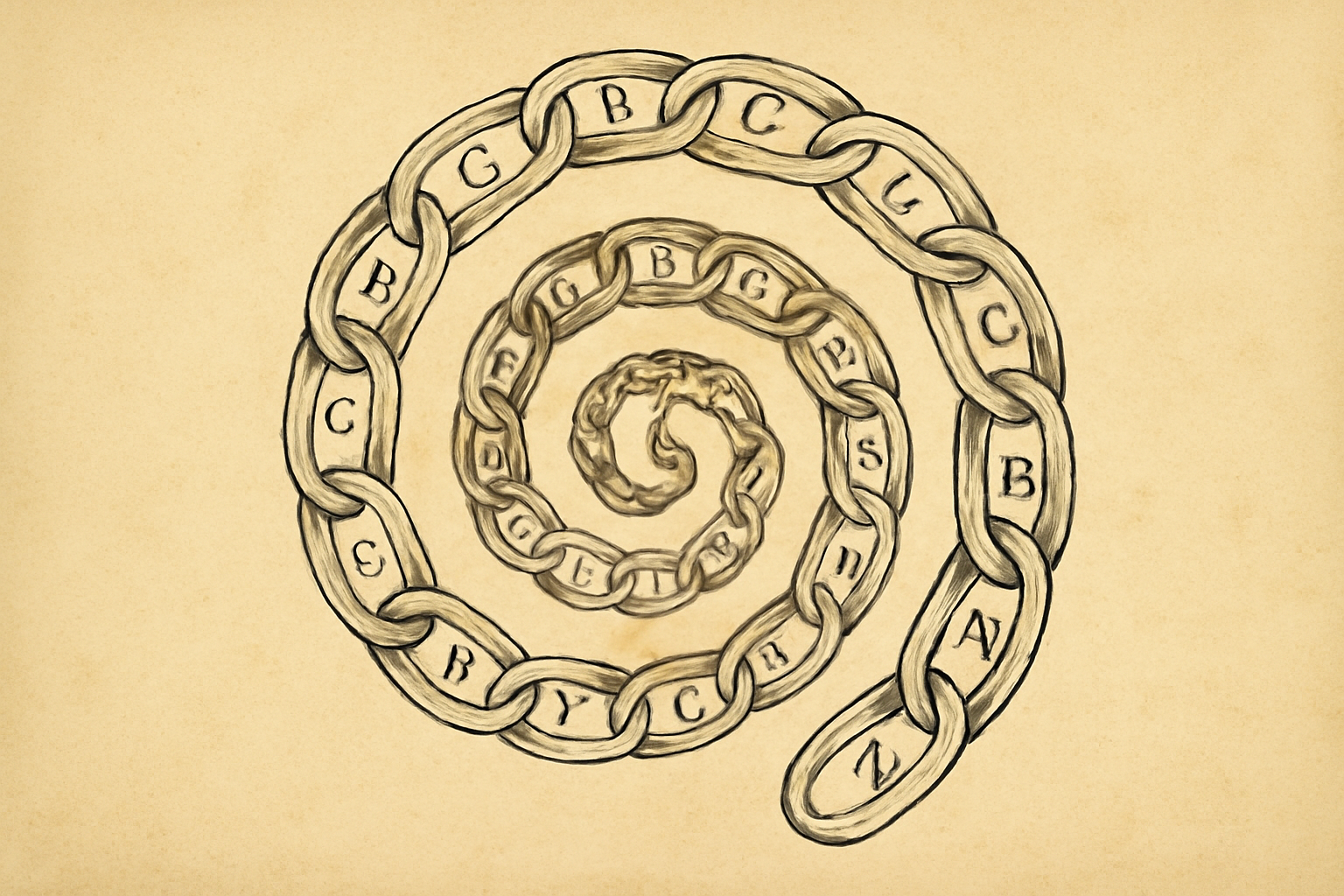
Terza rima is a rhyme scheme of interlocking tercets: ABA BCB CDC DED and onward. Notice what happens? That middle line of each stanza becomes the first and third line of the next. You’re trapped in a chain.
Read a few stanzas and you’ll feel it. Your eye can’t rest. Each tercet pulls you into the next one. It’s hypnotic. Endless. Falling.
This is not accidental design. Dante chose terza rima specifically for the Inferno. The form itself becomes content. The rhyme scheme mirrors the descent into hell—each circle pulling you deeper, each stanza hooking the next. You become Dante. You become trapped.
Form is meaning here. This matters enormously for translation.
Why Italian Can Do This (And English Can’t)
Italian is a rhyme-rich language. Almost every word ends in a vowel: -are, -ire, -ore, -ato, -uto, -ita, -ente. This creates an embarrassment of rhyming options.
Want five words rhyming with “amore” (love)? Try: dolore, cuore, signore, splendore, terrore. They’re everywhere. Finding rhymes in Italian is like finding sand on a beach.
English? English is rhyme-starved.
Try rhyming “journey.” Go ahead. I’ll wait. Maybe “attorney”? That’s it. That’s the list. Now try “spirit.” We have… “near it”? That’s not a word. We have to say “come near it,” which is clunky.
English evolved from Germanic and French roots. Our consonant clusters don’t play nice with rhymes. Our syllable stress patterns are irregular. We have fewer vowel sounds per word-ending.
As a result, English translators face an impossible math problem: maintain terza rima’s interlocking pattern while also translating Dante’s actual meaning? Something has to give.
The All-In Approach: Dorothy Sayers and the Rhyme Purists
Dorothy L. Sayers (1949) made a bold choice: keep full terza rima. All the rhymes. All the tercets. All the interlocking chains.
Here’s what she achieved at the opening of Inferno, Canto III (the gate of Hell):
Per me si va ne la città dolente,
— Dante Alighieri, Inferno III.1-3
per me si va ne l’etterno dolore,
per me si va tra la perduta gente.
Sayers renders it:
Through me the way into the city of woe;
— Dorothy Sayers’ translation
Through me the way to sorrow without end;
Through me the way among the lost below.
Beautiful! It rhymes perfectly. It’s sing-song. But notice: Sayers adds words. “The way” appears three times (Dante says “si va”—literally “one goes”). She needed “through me the way” to fill space and hit her rhyme.
This is the cost of rhyme-fidelity. You add padding. You rearrange syntax. Meaning bends.
Over 14,233 lines, those small distortions accumulate. You’re reading Dante-plus-padding, not pure Dante.
That said, Sayers’ version has genuine magic. The rhyme does pull you forward. New readers often prefer it—the sound carries them through.
The Compromise: Slant Rhyme and the Ghost of Form
Robert Pinsky (1994) took the middle path. He uses slant rhyme—near-rhymes, assonance, consonance. Not perfect rhyme, but a rhyming echo.
Here’s his version of the same tercet:
Through me you enter into the city of grief;
— Robert Pinsky’s translation
Through me you enter into eternal pain;
Through me you enter where the lost ones live.
Notice: grief/pain/live. These don’t rhyme perfectly. But they create a sonic kinship. Your ear hears the echo of the rhyme scheme without the artificiality.
Pinsky’s syntax is closer to Dante’s meaning. He adds less padding. Yet you still feel the form’s pull—slightly dimmed, but present.
This is clever. But it’s also a compromise. Some readers find slant rhyme unsatisfying. Others find it honest—acknowledging English’s limitations while respecting Dante’s meaning.
The Surrender: Blank Verse and Accuracy First
Henry Wadsworth Longfellow and Allen Mandelbaum made a different choice: abandon rhyme entirely. Prioritize meaning.
Here’s Longfellow (1867):
Through me the way into the city of woe;
— Henry Wadsworth Longfellow’s translation
Through me the way to everlasting pain;
Through me the way among the people lost.
Notice: zero rhymes. These lines are blank verse—unrhymed iambic pentameter. Longfellow prioritized literal accuracy over form.
What does this gain? Precision. These 12 words stick very close to Dante’s Italian. No padding. No forced syntax.
What do we lose? The relentless pull of terza rima. The hypnotic descent. The form-as-content that Dante engineered so carefully.
Reading Longfellow is like reading Dante in a hospital waiting room. Calm. Accurate. But not immersive.
The Reimagining: Seamus Heaney’s Sonic Alternative
Seamus Heaney (1999) tried something radically different for his translation of Canto III. He abandoned terza rima entirely—but he didn’t surrender momentum.
Instead, Heaney used what he called “a new music”—English alliteration, stress patterns, and sonic clustering. Different scaffolding for similar emotional effect.
Through me the way among the people lost,
— Seamus Heaney’s translation
Through me the way into eternal pain,
Through me the way among the lost forever.
Heaney uses repetition and alliteration (“Through me… Through me… Through me”). The repeated phrase pulls you forward like the rhyme scheme would.
It’s not terza rima. But it’s not formless either. Heaney substituted one kind of forward momentum for another. Genius and honest.
Why This Matters More Than Technicality
Here’s what many readers miss: the terza rima problem isn’t abstract. It’s visceral.
Reading terza rima, you feel trapped. Each stanza hooks the next. You can’t stop. You descend. The form mirrors your journey into hell.
When you read a translation without rhyme or with slant rhyme, you lose that physical sensation. You’re reading about the descent. You’re not experiencing it.
Dante knew this. He didn’t choose terza rima arbitrarily. It was essential to the Inferno‘s power.
Every translation must decide: What matters most? Fidelity to form or fidelity to meaning? Speed or accuracy? Music or precision?
There is no single right answer.
The Impossible Task (And Why That’s Wonderful)
Is there a perfect solution? No. English cannot replicate Italian’s rhyme abundance without doing violence to meaning. That’s structural fact, not failure.
But here’s what I love: the impossibility makes translation interesting. Every translator must make real choices. Each choice reveals something about the language, the form, and Dante himself.
Sayers shows us what happens when you worship form. Longfellow shows us what accuracy sounds like stripped bare. Heaney shows us that music can be reinvented. Pinsky shows us the middle ground—messy but honest.
As a reader, you benefit from comparison. Read two or three translations of the same canto. Watch how each translator negotiates the terza rima problem. Notice what’s gained and lost in each choice.
That’s when translation becomes not a pale copy, but a conversation. You’re inside Dante’s puzzle, watching intelligent people try to solve it different ways.
The terza rima problem isn’t a bug in translation. It’s a feature—proof that form and meaning cannot be divorced, and that moving language between worlds is never simple.
Which is exactly why I keep reading.
“`