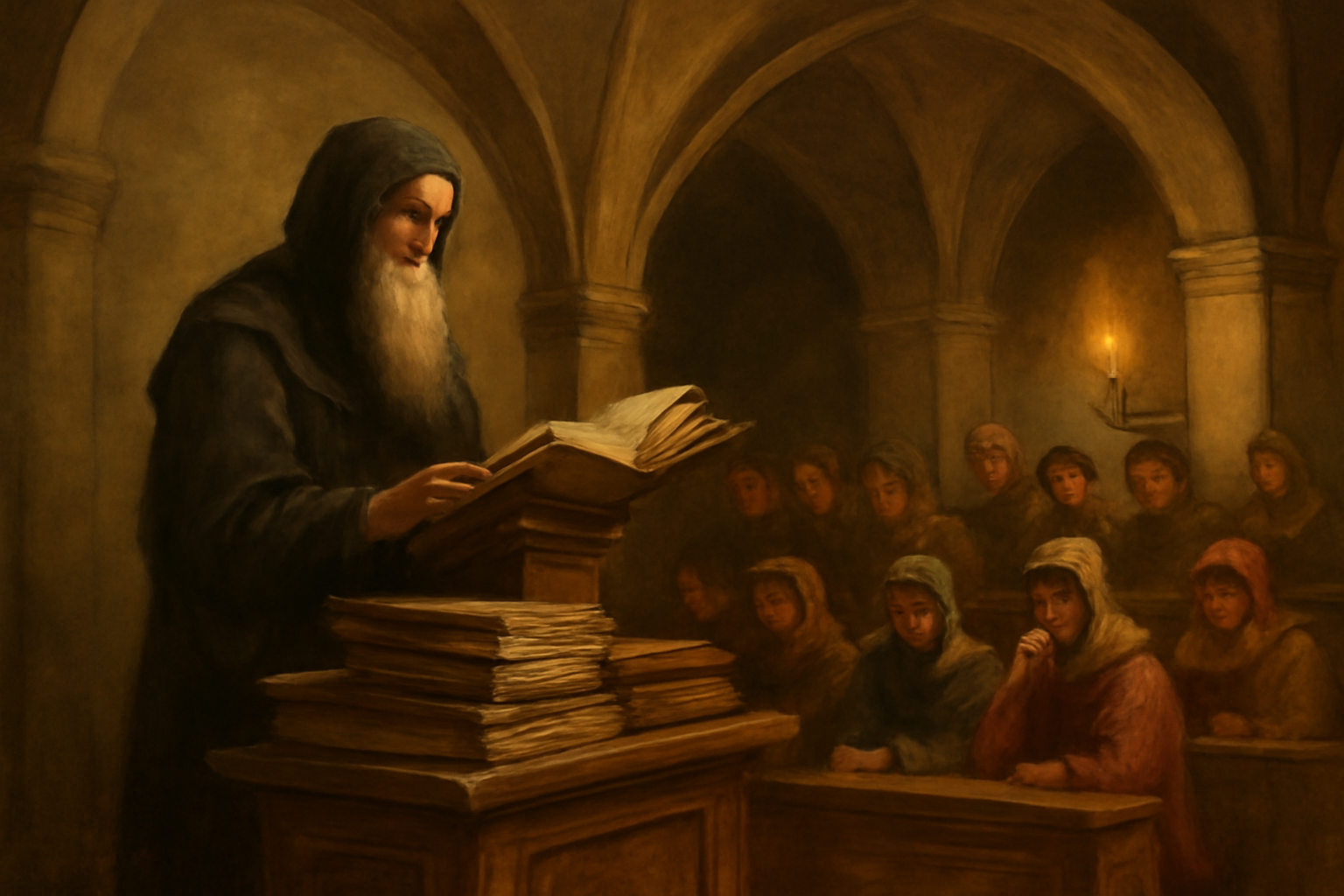
Dante died in 1321, but by the 1330s, something extraordinary was happening across Italian cities. Civic authorities hired scholars—publicly, formally—to lecture on the Divine Comedy to crowded rooms of paying listeners. No poem had ever demanded this kind of organized interpretation before. Within a few decades, four major commentaries emerged that would shape how readers understood Dante for centuries. These weren’t detached scholars writing in dusty libraries. They were the first Dante fans—trying urgently to explain to their contemporaries what this bewildering, brilliant poem actually meant.
Boccaccio: The Storyteller Explains the Story
Giovanni Boccaccio—yes, the Boccaccio of the Decameron—gave public lectures on the Commedia in Florence starting in 1373. He built his Esposizioni sopra la Comedia directly from those lectures. Here’s the catch: it only covers Inferno, cantos 1 through 17. Illness forced him to stop.
But what a commentary it is. Boccaccio was first and foremost a storyteller. Even explaining Dante’s verse, he digresses entertainingly—telling you the full legend behind a demon, or the political history of a Florentine family Dante mentions. He moves seamlessly between literary analysis and biography, weaving in details from his own Trattatello in laude di Dante (the first true Dante biography).
The result reads less like scholarly annotation and more like a wise friend walking you through the poem. He pauses often to tell you things you need to know. That generosity—that willingness to assume you might not understand—makes Boccaccio invaluable even now.
Benvenuto da Imola: The Comprehensive Witness
Benvenuto da Imola approached the problem differently. His lectures in Bologna (1370s–1380s) produced a commentary covering the entire Commedia in meticulous Latin. In fact, Benvenuto had access to people who remembered Dante personally and his world directly.
He writes in Latin, but constantly quotes Dante’s Italian and explains it word by word. This dual-language approach made him enormously influential. For Renaissance scholars reading Dante across Europe, Benvenuto’s Latin framework was the gateway. His commentary remains one of the most comprehensive and historically grounded of all medieval Dante glosses.
The Ottimo Commento and Francesco da Buti
An anonymous author wrote the Ottimo Commento (c. 1333) in Italian, near-contemporary with Dante’s death. Its name—meaning “excellent”—came later. The real value? Being written by someone living in the same political world Dante inhabited. The commentator knew the context.
Francesco da Buti lectured in Pisa in the 1380s–1390s. His commentary is thorough, covering all three canticles with particular skill at explaining Dante’s philosophical and theological sources. That said, he’s less entertaining than Boccaccio and less historically grounded than Benvenuto. He’s still essential for understanding how educated Italians read their greatest poet.
Why This Matters Now
Modern English translators of Dante consult these commentaries constantly. When you read a footnote explaining an obscure mythological reference or a Florentine political allusion, the explanation likely traces back to these 14th-century scholars. They were solving the same puzzle.
Access them through the Dartmouth Dante Project (searchable versions of all major commentaries) or Digital Dante at Columbia. Reading these texts is reading the first conversations about what made Dante matter—and they’re still speaking.
About This Article

Written by Lucy Bamboo. Lucy Bamboo has been reading the Divine Comedy for fifteen years — first in translation, then stubbornly in Medieval Tuscan with a dictionary and far too many footnotes. Reading Dante is her scene-by-scene walk through the poem: the original Italian, seven centuries of scholarly argument presented as argument rather than answer, and the human questions sitting underneath the theology. More about this site.
Verify this against a primary source
Specifics change, and your situation may differ from the one described here. These are the authorities worth checking directly:
- Digital Dante, Columbia University — text, commentary and translation apparatus
- Princeton Dante Project — the Commedia with historical commentary
- Dartmouth Dante Project — searchable commentary from 1322 onward