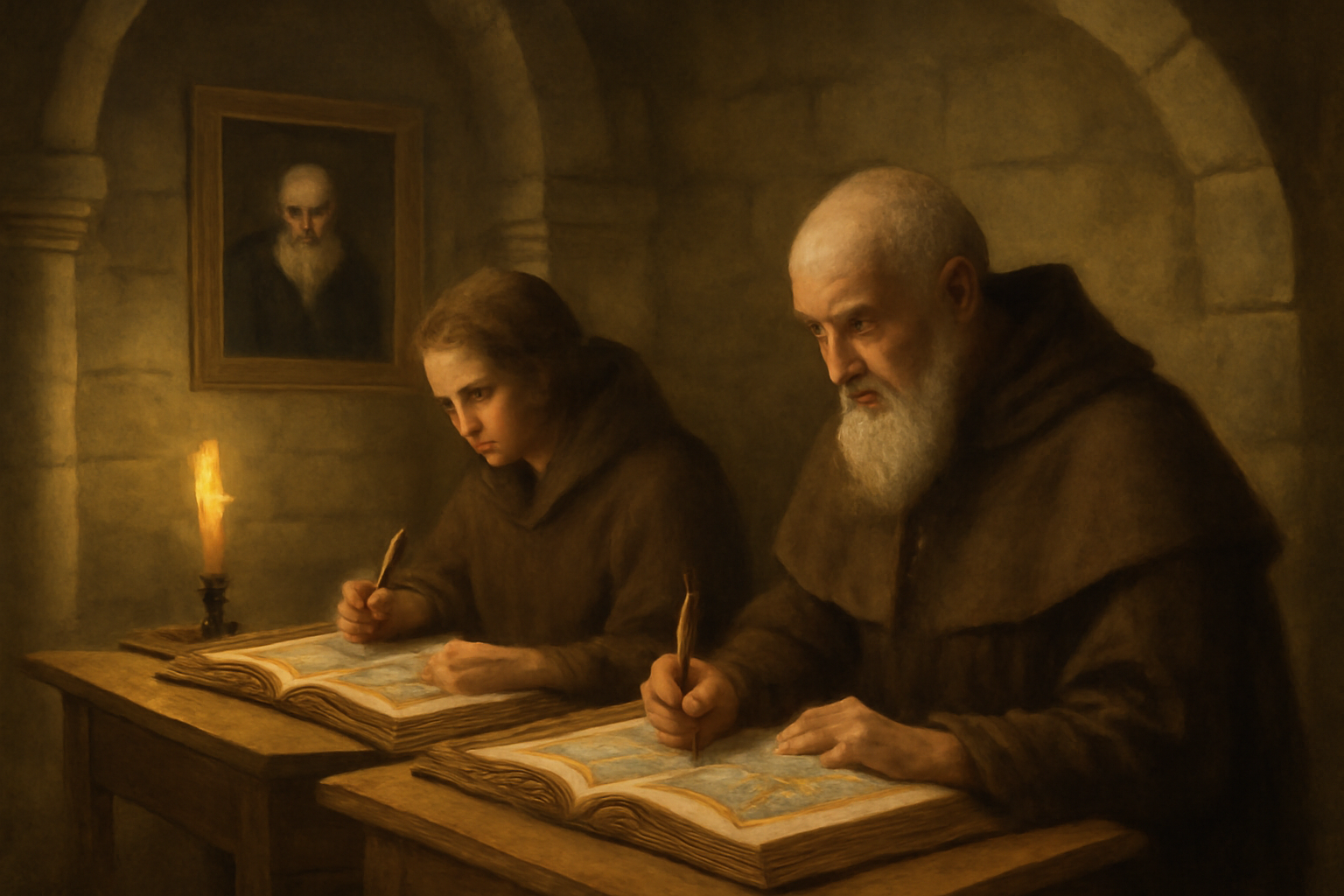
Imagine your father writes the greatest poem in your language. Now imagine sitting down to explain it to the world. That’s exactly what Pietro and Jacopo Alighieri did—and their commentaries are fully public domain.
Dante died in 1321. Within a year, his sons were already interpreting the Divine Comedy. Their readers struggled with Dante’s medieval Italian and dense theological references. These weren’t distant scholars offering hindsight. They were family members who had heard their father’s intentions firsthand.
Jacopo’s Gift: Making Dante Approachable
Jacopo Alighieri moved quickly. His commentary on the Inferno appeared around 1322—just months after his father’s death. His goal was simple: make this intimidating masterpiece readable.
Jacopo’s approach was gentler than what would come later. He explained difficult passages in clear language. He avoided dense theological arguments. For modern translation readers, this matters enormously. Jacopo shows us how the first generation of readers actually encountered Dante—not through scholarly apparatus, but through a son’s patient voice.
He also wrote a compressed summary poem called the Divisione. This work condenses the entire Commedia into digestible form. Think of it as medieval Cliff’s Notes written by someone with genuine stake in the author’s reputation.
Pietro’s Scholarship: A Jurist’s Commentary
Pietro took a different path. As a trained jurist, he brought legal and philosophical rigor to his father’s text. His commentary was more substantial—and more complex—than Jacopo’s.
He didn’t stop at one version. We have three known revisions of his work. Each one shows him wrestling with difficult passages, reconsidering interpretations, sometimes disagreeing with other early commentators. In fact, these disagreements are fascinating. When Pietro disputes another scholar’s reading of a canto, he may be defending what Dante actually told him at dinner.
Unlike Jacopo, he covered all three cantiche—Inferno, Purgatorio, and Paradiso. His commentary is the more ambitious project. For readers serious about understanding Dante’s architecture, Pietro’s legal mind offers structural insights that pure literary commentary misses.
About This Article

Written by Lucy Bamboo. Lucy Bamboo has been reading the Divine Comedy for fifteen years — first in translation, then stubbornly in Medieval Tuscan with a dictionary and far too many footnotes. Reading Dante is her scene-by-scene walk through the poem: the original Italian, seven centuries of scholarly argument presented as argument rather than answer, and the human questions sitting underneath the theology. More about this site.
Verify this against a primary source
Specifics change, and your situation may differ from the one described here. These are the authorities worth checking directly:
- Digital Dante, Columbia University — text, commentary and translation apparatus
- Princeton Dante Project — the Commedia with historical commentary
- Dartmouth Dante Project — searchable commentary from 1322 onward