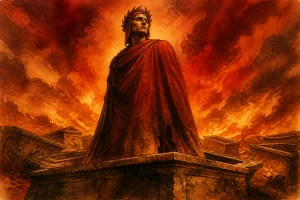
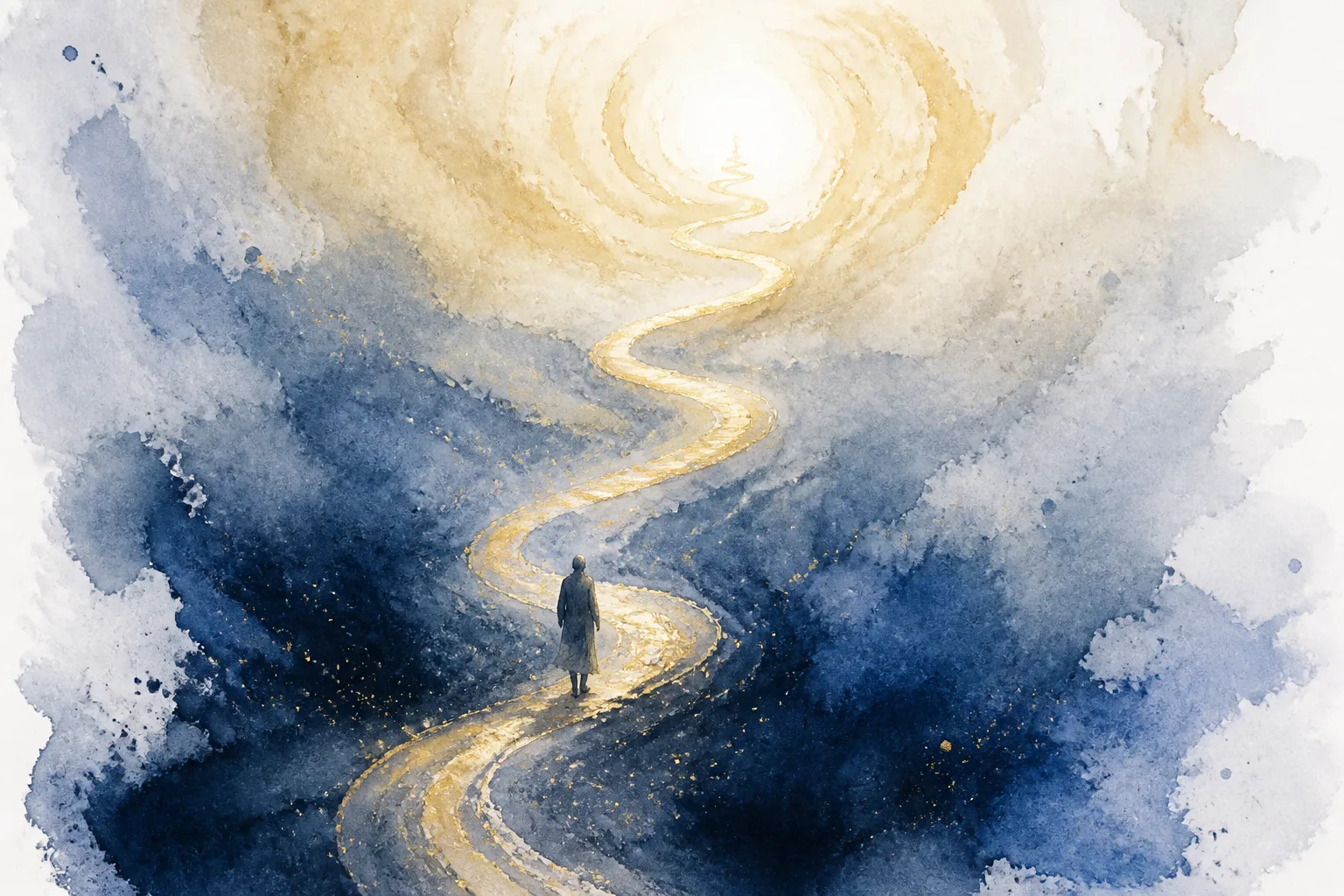
We say “return to God” the way we say “return home” — as if it’s obvious where you started. But notice what the word assumes. You can only return to a place you’ve already been. Dante’s entire cosmos rests on a claim most of us never examine: that the soul is going back, not forward — that the destination is also the origin, and that being lost is really just being far from a home you can’t quite remember. The poem isn’t a journey to God. It’s an argument that you came from there.
Which means the first question isn’t “will I make it?” It’s “do I believe I started there?” And the honest answer for most contemporary readers is: no, we don’t think that. We think we started in a hospital and will end in the ground, and whatever happens between those two points is our business to make something of. We don’t feel like wayward travelers who’ve wandered from home. We feel like creatures who showed up in the middle of something we didn’t choose, doing our best.
So when Dante opens in a dark wood — midway through the journey of our life, I found myself in a dark forest, the straight way lost — the frame he’s offering isn’t despair at the human condition. It’s a specific diagnosis: disorientation, not annihilation. You’ve lost the straight way. There is a way. You knew it once. That’s the claim the whole poem runs on, and it’s worth refusing early, before the language has had time to make it feel inevitable.
Is the deepest human longing a desire for something genuinely new — or homesickness for something we’ve forgotten?
The Cosmos Is a Circle, and That’s a Claim
The structural fact most readers absorb without noticing: Dante’s universe is built on exitus-reditus — the great Neoplatonic and Christian arc in which everything flows out from God and returns to God. Creation isn’t a scattering into nothing. It’s an emanation that bends back to its source. The journey of the Comedy isn’t a straight line from dark wood to heaven; it’s a curve, and the geometry proves it. Dante descends to the center of the earth — the lowest possible point — and there something strange happens: the direction flips. What was down becomes up. Climbing past Satan’s haunches, he emerges into the southern hemisphere and begins the ascent of Purgatory. The nadir is the turn. The lowest point is where return begins.
This is elegant. It’s also a Neoplatonic inheritance filtered through Augustine and Aquinas, dressed in medieval cosmology, and it is emphatically not a neutral description of reality. It’s a theology of shape — a claim that existence has a structure, that the structure is circular, and that you are inside a story with a source and a home.
The modern reader mostly carries the opposite model. Life as a line. A one-way arrow from birth to death, from nothing to nothing, from a singularity that preceded your consciousness into a darkness that will follow it. No return because there was no departure. No home because there was no origin. When you’re done, you’re done.
Dante never argues with you about this directly. He simply builds a cosmos of such completeness and internal consistency that the circular model begins to feel like recognition rather than proposition. That’s not an argument; it’s a seduction — and recognizing it as such doesn’t make it less effective.
Is your life a line or a circle — a one-way trip from nothing to nothing, or a loop back to where you began? Almost everything you feel about death depends on which. And neither can be proven from inside the experience of being alive.
You Have to Be Unmade to Go Back
Here is the part of “return to God” that the framing tends to soften, and shouldn’t. The ascent through Purgatory is not additive. Dante doesn’t accumulate his way to God — more virtue, more knowledge, more grace, until he’s finally enough. He’s stripped. The mountain of Purgatory is a place of purgation, of burning off, not of building up. The grudges, the specific textures of failure and pride, the particularity of a damaged self — these are what the mountain removes.
At the summit, before ascending to Paradise, Dante drinks from Lethe, and he forgets his sins. This sounds merciful until you press it: what exactly is being forgotten? Not just the actions — the remorse, the memory, the specific way those particular failures shaped this particular person. The self that arrives in Paradise is lighter. The self that arrives in Paradise is also less.
Push this where it wants to go: “return to God” might require the dissolution of exactly the self that wants to return. The contingent self — wounded, particular, specific to this body and this history — has to be burned off. What persists is something. But it’s not obviously you, not the you who picked up this book, who failed that person, who carried those regrets through decades. If you return having shed everything that made you you, did you return? Or did something else survive, wearing your soul lightly, no longer recognizably the person who made the trip?
This is the implication the rest of the poem orbits without quite facing. The homecoming requires a kind of dying-before-death. What you’re betting on is that you are not primarily your wounds, your memories, your history of failure and love and damage — that there’s a core underneath all of that which is the real you, and the rest is just what happened to it.
If coming home to God means losing the specific, wounded, particular person you are now, is that homecoming — or a beautiful kind of death?
The Ache That Points — or Doesn’t
The emotional engine of the poem, and Dante’s most psychologically modern move, is that the pull toward God is rendered not as duty or doctrinal obligation but as desire — a restlessness, a longing that nothing earthly can finally quiet. He inherits this directly from Augustine: “our heart is restless until it rests in you.” But Dante doesn’t quote it; he stages it. The whole long structure of the Commedia — the accumulated encounters, the failures of human beauty and human achievement to hold, the way Beatrice’s eyes keep drawing him further — is a dramatization of the thesis that human desire has a terminal address, and everything short of it is a rest stop.
The claim embedded in “return” is that the ache is evidence — not just a feeling, but a signal. A compass pointing to a magnetic north that’s actually there. You feel the pull because you belong there. The restlessness isn’t neurosis or evolutionary noise. It’s a homing instinct, and it proves the destination.
But the exact same restlessness has a completely different reading. Maybe the ache isn’t evidence of a home you’re being called back to. Maybe it’s just what a finite creature feels — a wanting without a final object, a desire that runs past every satisfaction because desire is its own engine and has no natural terminus. Maybe “God” is the name we give to the silence at the end of it. A beautiful name, even a necessary one, but not a destination — a projection, the shape we pour our longing into because longing wants a shape.
When nothing you achieve ever feels like enough, is that a signal pointing somewhere real — or just the structure of desire itself, which is constitutionally unsatisfiable, pointing nowhere in particular?
Why the Circle Might Be the Only Structure That Holds
The strongest case for the reditus structure isn’t theological. It’s about the conditions under which anything at all can matter.
A line that starts nowhere and ends nowhere cannot carry weight. If you came from nothing and return to nothing — if there is no origin, no source, just a random coalescence of matter that briefly became conscious and then stopped — then every choice is finally weightless, washed out by the same blankness at both ends. You can still have preferences, still love people, still feel that some things matter more than others. But the frame keeps collapsing back on itself.
The reditus structure does something a line cannot: it gives existence directionality, which is the precondition for meaning. If you come from somewhere and return to somewhere, you are oriented. Your choices are not weightless — they are movements in a space that has a shape. The contrapasso, the moral logic behind every punishment Dante designs, only makes sense inside this structure — movement toward or away from God is real movement in a real direction, not metaphor.
“Return” isn’t wishful thinking on this reading — it’s the claim that you are situated, that your life has a vector, that there is a direction to existence and you can measure your distance from it. The secular reader who rejects the metaphysics still has to reckon with what they’re giving up: not just heaven, but the possibility of a cosmos in which mattering is something other than a local and temporary arrangement we perform for each other until we can’t anymore.
Can a life that comes from nowhere and goes nowhere still mean something — or does meaning require an origin and a destination, whatever you call them?
The Vision Fails
Dante gets there. Paradiso XXXIII, the final canto, the Beatific Vision — the soul at its source, the destination of the entire poem, the end of the return. And at the exact moment of arrival, the poem breaks: “here power failed the high imagination.” He makes it. And he cannot report it.
The homecoming is real and incommunicable. He comes back to daylight — to language, to the Comedy itself, to us — unable to carry the home back with him. He remembers the impression the way you remember a dream: not the content, but the force of it, the fact that something happened. What he brings back is not the vision but the certainty that there was one, and the inadequacy of everything he can say about it.
The entire Commedia is an act of return, and its destination is the one place that cannot be returned from in the sense of carried back, translated, reported. Even “return to God” contains a second, crueler return — back down into ordinary life, into a body that cannot hold what it touched, into language which by definition is not the thing itself. The poem that was supposed to be the account of the return becomes, at its climax, the record of its own failure to account for it.
Whether grace enables such an arrival or whether it simply arrives is a question the poem circles without closing. What you’re left with is the testimony of someone who says the destination is real and the arrival was real — and you’re taking it on faith, because the destination is precisely what cannot be transmitted.
If you reached the thing all your longing pointed at, and couldn’t bring any of it back — would you call that arrival, or just a rumor of arrival you have to take on faith?
The Turn That Refuses to Close the Circle
The reader came, probably, for some version of reassurance. The comforting promise that the ache means something, that there’s somewhere to go, that “return” is the truest word in the language. Dante offers the most complete version of one possibility: that existence is a circle, that the longing is a homing signal, that you’re going back. He builds it so thoroughly — cosmos, geometry, theology, psychology, the full apparatus of medieval and Neoplatonic thought — that you can feel the pull of a universe you may not believe in.
But the building was an act of faith, not a discovery. Dante chose the circle. He didn’t find it inscribed in the structure of things and then report it; he inherited a tradition that described reality as exitus-reditus, found it true to his experience, and spent a hundred cantos making it luminous. The choosing came first.
The modern reader stands exactly where Dante stood before he chose — with the same ache, the same inability to remember an origin, the same inability to see a destination. From inside a single life, neither model can be confirmed. You can live as if you’re on your way back. You can live as if this is all there is and the task is to make something of it before the lights go out. Each orientation shapes everything: your relationship to failure, to loss, to other people, to your own death.
The word “return” is either the truest word in the language — the word that names what all longing is actually doing — or the most beautiful thing human beings ever made up to bear being finite. From inside the longing, you cannot tell which. Dante couldn’t either, which is perhaps why he needed a hundred cantos to work it out, and why the last lines of the poem, after everything, give him back to the ordinary world: moving, like the sun and the other stars, by love.
He doesn’t say: and now I know. He says: I was moved. That’s what he brought back. Whether it’s enough is a question only you can answer, and the answer will depend on something you chose before you could name what you were choosing.
About This Article

Written by Lucy Bamboo. Lucy Bamboo has been reading the Divine Comedy for fifteen years — first in translation, then stubbornly in Medieval Tuscan with a dictionary and far too many footnotes. Reading Dante is her scene-by-scene walk through the poem: the original Italian, seven centuries of scholarly argument presented as argument rather than answer, and the human questions sitting underneath the theology. More about this site.
Verify this against a primary source
Specifics change, and your situation may differ from the one described here. These are the authorities worth checking directly:
- Digital Dante, Columbia University — text, commentary and translation apparatus
- Princeton Dante Project — the Commedia with historical commentary
- Dartmouth Dante Project — searchable commentary from 1322 onward