The 1913 Catholic Encyclopedia: An Underrated Key to Understanding Dante’s Theology

The 1913 Catholic Encyclopedia: An Underrated Key to Understanding Dantes Theology

Dante’s Comedy is a theological poem. You can enjoy it without understanding the theology, but you’ll miss the architecture of the entire work. The 1913 Catholic Encyclopedia — free, public domain, available at newadvent.org — is the single best tool for filling those gaps. I discovered this by accident. While reading Paradiso, I hit a … Read more

The Beatific Vision: What Dante Sees at the End of Paradiso and Why It Matters

The Beatific Vision: What Dante Sees at the End of Paradiso and Why It Matters

I spent months reading Paradiso without understanding where the poem was actually going. Canto after canto of Dante ascending through spheres of light, meeting saints and theologians—it felt magnificent, but untethered. Then I grasped the Beatific Vision, and everything clicked. The entire Divine Comedy—all three canticles—points toward this one moment: standing face-to-face with God. What … Read more

Francesca’s Voice: How Translators Shape the Most Heartbreaking Scene in Dante

Francescas Voice: How Translators Shape the Most Heartbreaking Scene in Dante

I have read Dante’s Canto V perhaps forty times. Each time, I weep. Not because I don’t understand it—I do—but because understanding it feels impossible. This is the paradox of the Francesca da Rimini episode. It moves us most when we’re uncertain what we should feel. The text itself doesn’t change. But the translation does. … Read more

Limbo, Purgatory, and the Harrowing of Hell: Dante’s Afterlife Geography Explained

Limbo, Purgatory, and the Harrowing of Hell: Dantes Afterlife Geography Explained

Dante’s Divine Comedy isn’t just poetry—it’s a cosmic blueprint. His afterlife has geography, physics, and logic. Understanding the map unlocks the theology. Think of it this way: distance from God measures everything. Where you are tells you who you are. Hell: A Funnel to Nowhere Hell is a vast cone boring downward through Earth’s crust … Read more

Dante’s Own Sons Wrote Commentaries on the Commedia And You Can Read Them for Free

Dantes Own Sons Wrote Commentaries on the Commedia  And You Can Read Them for Free

Imagine your father writes the greatest poem in your language. Now imagine sitting down to explain it to the world. That’s exactly what Pietro and Jacopo Alighieri did—and their commentaries are fully public domain. Dante died in 1321. Within a year, his sons were already interpreting the Divine Comedy. Their readers struggled with Dante’s medieval … Read more

Contrapasso Explained: The Moral Logic Behind Every Punishment in Dante

Contrapasso Explained: The Moral Logic Behind Every Punishment in Dante

Contrapasso is the organizing principle of Dante’s Hell. The Inferno is not a warehouse of arbitrary torments, but a mirror of moral truth. Once you understand contrapasso, the entire architecture clicks into place. Every punishment doesn’t just fit the sin—it reveals what the sin actually was. The word itself comes from Latin: contra (against) + … Read more

From Longfellow to Mary Jo Bang: 150 Years of Translating the Inferno Into American English

From Longfellow to Mary Jo Bang: 150 Years of Translating the Inferno Into American English

Translations · 1800 words · Updated with expanded scholarship America’s Strange Obsession With Translating Dante Here is a paradox worth sitting with: the United States has produced more significant English translations of Dante’s Inferno than Britain, Australia, and Canada combined — despite having no medieval Catholic heritage, no Romance language in its founding culture, and … Read more

Boccaccio, Benvenuto, and the First Dante Scholars: Medieval Commentaries You Can Read Today

Boccaccio, Benvenuto, and the First Dante Scholars: Medieval Commentaries You Can Read Today

Dante died in 1321, but by the 1330s, something extraordinary was happening across Italian cities. Civic authorities hired scholars—publicly, formally—to lecture on the Divine Comedy to crowded rooms of paying listeners. No poem had ever demanded this kind of organized interpretation before. Within a few decades, four major commentaries emerged that would shape how readers … Read more

A Pocket Guide to Dante’s Pronouns: Tu, Voi, and the Politics of Address

A Pocket Guide to Dantes Pronouns: Tu, Voi, and the Politics of Address

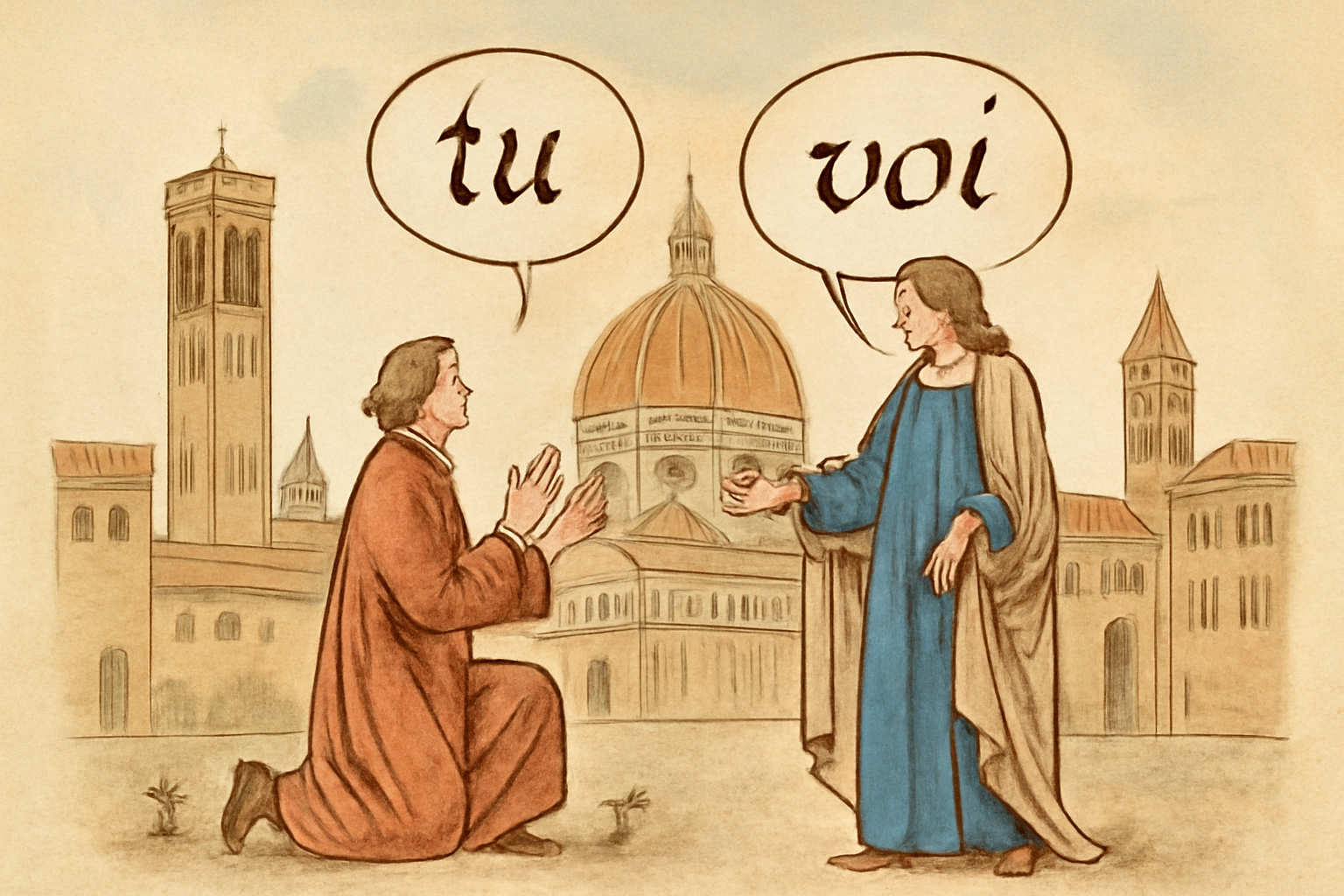
I didn’t realize how much drama was hidden in Dante’s pronoun choices until someone pointed it out. Now I can’t un-see it. Every time I reread the Commedia, I catch myself watching for those tiny Italian words—tu and voi—like they’re secret messages written in plain sight. And honestly? They are. In medieval Tuscan Italian, the … Read more

Lost in Translation: Italian Words in Dante That Have No English Equivalent

Lost in Translation: Italian Words in Dante That Have No English Equivalent

Some of Dante’s most important words don’t have English equivalents. They sit in a gap between Italian and English, refusing to be pinned down. Every translator faces this gap, and every choice sacrifices something. This isn’t a failure of English. It’s an invitation to wonder: what does a language reveal by what it CAN’T say? … Read more